Markus Castro
This Guy Survived the Titanic, Refused to Let a Doctor Take His Legs, and Won the US Championships Two Years Later
Table of Contents
Surviving the sinking of the Titanic would have been enough to make anyone’s life extraordinary. But for Richard Norris Williams II, escaping one of history’s deadliest maritime disasters was only the beginning of an even more remarkable story.
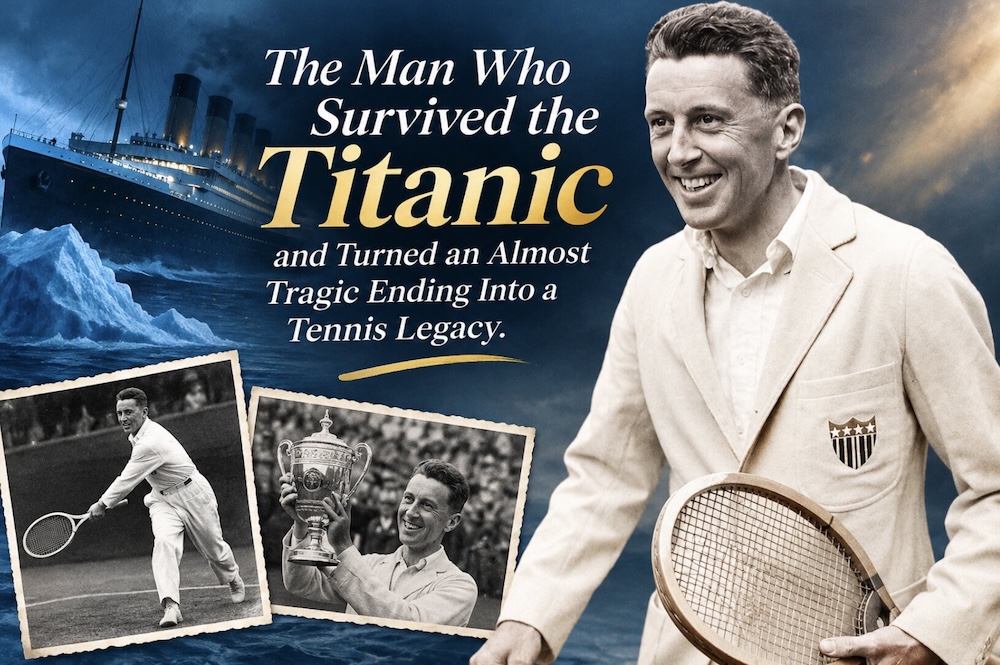
After spending hours in the freezing waters of the North Atlantic, Williams was rescued with severe injuries to his legs. Doctors reportedly recommended amputating both legs to prevent further complications. He refused.
Instead, the young tennis player fought to recover, returned to the court, and accomplished something few people could have imagined. Just two years after the Titanic disaster, he won the US National Championships men’s singles title. He eventually became a two-time national singles champion, a Wimbledon doubles champion, and an Olympic gold medalist.
His story is a remarkable reminder of what determination can accomplish, even after facing seemingly impossible circumstances.
Aboard the Titanic: A Voyage That Changed Everything
Richard Norris Williams was born on January 29, 1891, in Geneva, Switzerland, to American parents. He grew up in Europe, where his father, Charles Duane Williams, encouraged him to take up tennis.
By 1912, Richard was already showing promise as a tennis player. He and his father boarded the RMS Titanic at Cherbourg, France, on April 10, 1912. They were traveling to the United States, where Richard planned to continue his education at Harvard University.
Their journey, however, would end in tragedy.
On the night of April 14, the Titanic struck an iceberg in the North Atlantic. As the ship began to sink, passengers scrambled for lifeboats and tried to escape the freezing water.
Richard and his father eventually jumped into the ocean. Richard survived, but his father did not. The young athlete later recalled seeing his father disappear during the chaos, a heartbreaking experience that stayed with him for the rest of his life.
Richard reached a partially submerged lifeboat, where he and other survivors struggled to stay afloat. After hours in the freezing Atlantic, the RMS Carpathia, which responded to the Titanic’s distress calls, eventually rescued him.
Although he had escaped the disaster, his ordeal was far from over.
Doctors Recommended Amputating His Legs. He Refused.
When Richard was rescued, his legs had suffered severe injuries after prolonged exposure to the freezing water.
The damage was serious enough that a doctor aboard the Carpathia reportedly recommended amputating both legs to prevent complications, including gangrene.
For a young man who had spent years developing his tennis career, losing his legs would have meant a completely different future.
But Richard was not ready to give up.
He refused the recommendation and reportedly insisted that he needed his legs. Instead of accepting the proposed surgery, he began walking around the ship’s deck every two hours, even at night, to restore circulation to his injured limbs.
It was an incredible display of determination. He had just survived a shipwreck, lost his father, and endured hours in freezing water. Yet he was already thinking about getting back on his feet.
Fortunately, his condition improved, and he eventually regained the use of his legs.
Looking back, this decision became one of the most remarkable parts of his life story. The same legs doctors had considered removing would eventually carry him back to the tennis court and help him win major championships.
Back on the Tennis Court Just Months After the Titanic Disaster
Perhaps the most surprising part of Richard’s story is how quickly he returned to competitive tennis.
Just weeks after surviving the Titanic disaster, he was already making his way back to the sport he loved.
In the summer of 1912, he competed at the Longwood Challenge Bowl near Boston against another Titanic survivor and tennis player, Karl Howell Behr. Richard lost the match, but simply returning to competitive tennis after everything he had experienced was already remarkable.
That same year, he partnered with Mary K. Browne to win the US National Championships mixed doubles title.
Think about that for a moment. Richard had survived one of the most tragic events in maritime history, faced the possibility of losing both legs, and was already winning a major tennis championship within months.
His comeback was just getting started.
1914: From Titanic Survivor to US Tennis Champion
Two years after the Titanic sank, Richard reached another major milestone in his tennis career.
In 1914, he won the US National Championships men’s singles title, defeating defending champion Maurice McLoughlin in the final, 6-3, 8-6, 10-8.
The victory established him as one of the leading American tennis players of his generation.
He proved that his first championship was no fluke by winning the singles title again in 1916. This time, he defeated William Johnston in a five-set final.
His success extended beyond singles competition. Richard also collected several important doubles titles throughout his career.
Some of his notable achievements included:
- 1912: US National Championships mixed doubles champion with Mary K. Browne.
- 1914: US National Championships men’s singles champion.
- 1916: US National Championships men’s singles champion.
- 1920: Wimbledon men’s doubles champion with Chuck Garland.
- 1924: Olympic mixed doubles gold medalist with Hazel Hotchkiss Wightman at the Paris Games.
- 1925 and 1926: US National Championships men’s doubles champion with Vincent Richards.
He also represented the United States in the Davis Cup, helping his country compete successfully in the prestigious international team competition.
For someone who had nearly lost his ability to walk just a few years earlier, these accomplishments were extraordinary.
He Also Served During World War I
Richard’s life was not all about tennis.
During World War I, he served with the American Expeditionary Forces. His military service earned him recognition from France, including the Croix de Guerre and the Legion of Honour.
After the war, he returned to tennis and continued competing at a high level.
He eventually stepped away from competitive tennis, but his contributions to the sport were far from forgotten. In 1957, he was inducted into the International Tennis Hall of Fame for his outstanding career.
Outside sports, Richard also built a successful career as an investment banker in Philadelphia. He served as president of the Historical Society of Pennsylvania for 22 years.
He died on June 2, 1968, at the age of 77.
More Than Just a Titanic Survivor
More than a century after the Titanic sank, Richard Norris Williams remains one of the most fascinating figures in sports history.
His story is about much more than surviving a shipwreck. He lost his father during the disaster, spent hours in freezing water, and faced the possibility of losing both legs. Yet he refused to let those experiences determine the rest of his life.
He returned to tennis, won major championships, represented his country, served during wartime, and earned a place in the International Tennis Hall of Fame.
What makes his story particularly remarkable is the timeline. In 1912, he was fighting to save his legs after surviving the Titanic. By 1914, he was a US National Championships singles champion.
The legs a doctor reportedly recommended removing eventually carried him to two national singles titles, a Wimbledon doubles championship, and an Olympic gold medal.
Richard Norris Williams did not simply survive the Titanic. He went on to build a life and sporting career few could have imagined after that terrible night.
And that may be the most inspiring part of his story.
Follow us on Facebook and Twitter.
Read:
- Alex Eala Beats Svitolina, advances to DC Open semis
- Alex Eala’s Boyfriend: Is the Filipina Tennis Star Dating Anyone?