Markus Castro
How to Enroll in TESDA’s Free Online Courses: A Complete Guide for Filipinos
Table of Contents
Want to learn a new skill without paying tuition? The Technical Education and Skills Development Authority (TESDA) offers Filipinos an opportunity to do just that through its TESDA Online Program (TOP).
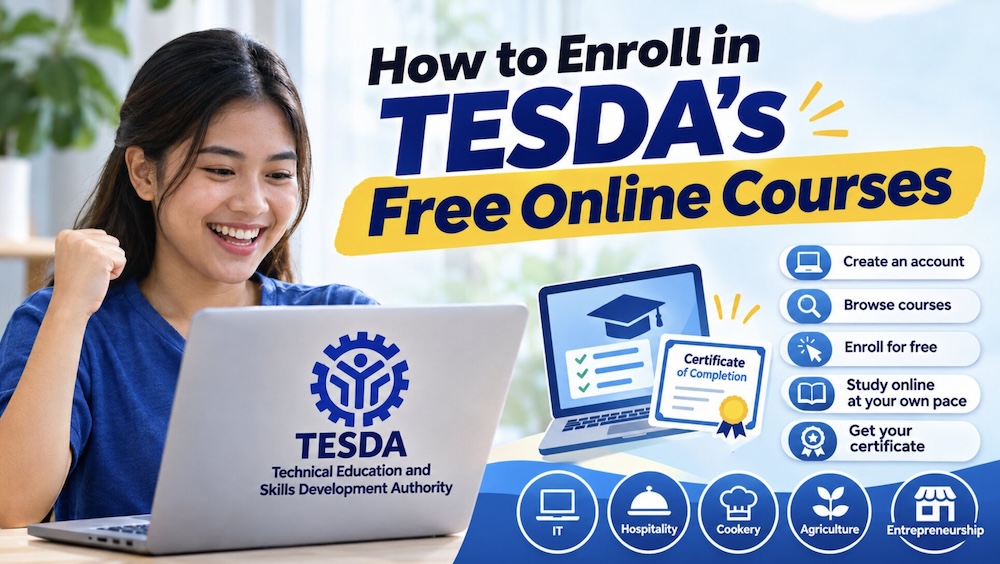
TOP is a free online learning platform where Filipinos can take courses in fields such as information technology, tourism, hospitality, agriculture, entrepreneurship, construction, and food preparation.
The program is designed for people who want to improve their skills but may not have the time or resources to attend regular classroom training. You can study at your own pace, making it a practical option for students, working professionals, unemployed individuals, parents, and even Filipinos working overseas.
Some of the industries covered by TESDA’s online courses include:
- Information and Communications Technology (ICT)
- Agriculture and fisheries
- Tourism and hospitality
- Construction
- Automotive and land transport
- Electrical and electronics
- Entrepreneurship
- Food processing and cookery
- Healthcare
- Language and communication
- Maritime
- Lifelong learning and workplace skills
The best part? You don’t have to pay tuition to access courses offered through the TESDA Online Program.
TESDA also has other free training opportunities, including face-to-face technical-vocational courses and scholarship programs. These have separate application procedures and eligibility requirements.
2. How to Enroll in TESDA’s Free Online Courses
Getting started with TESDA’s online courses is relatively easy. You don’t need to visit a TESDA office just to create an account and begin exploring the available lessons.
All you need is an internet connection, an active email address, and a smartphone, tablet, or computer.
Here’s how to get started.
Step 1: Visit the TESDA Online Program website
Open your browser and look for the official TESDA Online Program platform, also known as TOP or e-TESDA.
Make sure you’re using the official government platform. Be careful with websites or social media accounts offering TESDA enrollment in exchange for registration fees. The online courses offered through TOP are free.
Step 2: Create your learner account
Look for the registration or account creation option on the platform.
You will be asked to provide basic information, which may include:
- Full name
- Email address
- Username
- Password
- Other registration details
Use an email address that you regularly check. TESDA may use it to verify your account and send important course notifications.
Double-check your information before submitting the registration form.
Step 3: Verify your account
If you receive an account verification email, open it and follow the instructions.
Can’t find the email? Check your spam or junk folder.
Once your account is activated, return to the platform and log in using your registered username and password.
Step 4: Browse the available courses
After logging in, take some time to explore the course catalog.
TESDA offers courses across several industries, so it’s worth checking the different categories before deciding what to study.
For example:
- Interested in computers? Look for computer systems servicing and digital literacy courses.
- Planning to work in a hotel? Explore housekeeping and front office services.
- Love cooking or baking? Check the available cookery and food preparation courses.
- Thinking of starting a business? Look into entrepreneurship and small business management.
- Interested in farming? Explore agriculture and aquaponics-related training.
Read each course description carefully. Check the learning objectives, available modules, prerequisites, and other requirements before enrolling.
Step 5: Choose your preferred course
Once you find a course that matches your interests, open its course page.
Review the description and learning materials to understand what you will be studying. Some courses have several modules that must be completed in sequence.
Select the enrollment option and follow the platform’s instructions.
After enrolling, you should be able to access the course through your learning dashboard.
Step 6: Start studying
Now comes the learning part.
Depending on the course, the lessons may include:
- Reading materials
- Instructional videos
- Presentations
- Interactive activities
- Practice exercises
- Knowledge assessments
- Online quizzes
Take your time going through each module. You don’t have to rush through the lessons, especially if you’re learning something completely new.
One advantage of online training is that you can study during your free time. You can work on a lesson after office hours, during weekends, or whenever your schedule allows.
Step 7: Complete the required modules and assessments
Work through the lessons and complete the activities required by your chosen course.
Some courses include quizzes or assessments that you need to pass before moving to the next module.
Check your dashboard regularly to see your progress and identify any unfinished activities.
Step 8: Get your certificate of completion
Once you have completed the required course activities, check whether an electronic certificate of completion is available.
Keep a digital copy of your certificate. You can include it in your resume or professional portfolio as proof of additional training.
However, remember that a TESDA online course completion certificate is different from a TESDA National Certificate (NC). If you want an NC, you generally need to undergo a separate competency assessment and meet the qualification requirements.
3. Twenty TESDA Courses to Consider and Their Possible Career Opportunities
Not sure which course to take? Start with something related to your interests or the type of work you want to pursue.
TESDA offers learning opportunities in technology, tourism, hospitality, food preparation, agriculture, and entrepreneurship.
Here are 20 course examples to explore, along with some possible career paths.
The suggested jobs are examples of opportunities these skills may support. Completing an online course alone does not automatically qualify you for employment or professional certification.
A. Information Technology and Digital Skills
If you enjoy working with computers or want to improve your digital skills, consider exploring these courses.
| TESDA Online Course | Potential Career Opportunities |
|---|---|
| 1. Introduction to Computer Systems Servicing | Computer technician trainee, IT support assistant |
| 2. Installing and Configuring Computer Systems | Computer servicing assistant, hardware support technician |
| 3. Maintaining Computer Systems and Networks | IT support assistant, computer maintenance technician |
| 4. Microsoft Digital Literacy | Administrative assistant, office support staff, digital skills for freelancers |
| 5. Preparing Computer-Aided Drawings | CAD operator trainee, drafting assistant |
These courses are worth considering if you want to learn basic computer troubleshooting, hardware installation, digital tools, or technical drawing.
They can also serve as a starting point if you’re planning to pursue more advanced IT training.
B. Tourism and Hospitality
The Philippines has a large tourism and hospitality industry, creating opportunities for people interested in hotels, resorts, restaurants, and other tourism-related businesses.
Here are some courses to consider:
| TESDA Online Course | Potential Career Opportunities |
|---|---|
| 6. Providing Front Office Services | Hotel front desk assistant, reservations assistant |
| 7. Providing Guest Room Services | Housekeeping attendant, room attendant |
| 8. Providing Housekeeping Services | Hotel housekeeping staff, accommodation support |
| 9. Introduction to Food and Beverage Services | Restaurant service crew, food and beverage attendant |
| 10. Fundamentals of Professional Cookery | Kitchen assistant, cook trainee, food business operator |
These courses can help beginners understand the basics of hotel operations, guest services, housekeeping, and food service.
If you’re planning to work in a hotel, resort, restaurant, or cruise-related hospitality position, consider pairing online learning with practical training.
C. Cookery, Baking, and Food Preparation
Do you enjoy cooking or baking? TESDA also offers courses that can help you develop basic food preparation skills.
These may be useful if you’re interested in working in a restaurant or bakery, or if you’re thinking of starting a small food business.
| TESDA Online Course | Potential Career Opportunities |
|---|---|
| 11. Preparing Cakes | Bakery assistant, cake decorator trainee |
| 12. Preparing Desserts | Pastry assistant, dessert maker |
| 13. Preparing Sandwiches | Sandwich maker, food service assistant |
| 14. Preparing Seafood Dishes | Kitchen assistant, seafood cook trainee |
| 15. Preparing Salads and Salad Dressings | Salad preparation staff, kitchen assistant |
You can use what you learn as a starting point to experiment with recipes and improve your food preparation techniques.
For those planning to turn their cooking skills into a source of income, additional practical training and business knowledge can be helpful.
D. Agriculture and Entrepreneurship
TESDA also has courses for Filipinos interested in agriculture, food production, and starting their own businesses.
| TESDA Online Course | Potential Career Opportunities |
|---|---|
| 16. Introduction to Aquaponic Food Production | Aquaponics assistant, small-scale aquaponics entrepreneur |
| 17. Setting Up Aquaponics Systems | Aquaponics installation assistant, farm operator |
| 18. Introduction to Agro-Entrepreneurship | Agricultural entrepreneur, farm business assistant |
| 19. Assessing Market Opportunities | Market research assistant, agricultural business operator |
| 20. Establishing and Operating Micro-Small Medium Enterprises (MSMEs) | Small business owner, micro-entrepreneur |
Aquaponics, for example, combines fish production with growing plants in a connected system. Learning the basics can help beginners understand how this type of food production works.
Entrepreneurship courses are also worth considering if you want to start a small business but need a better understanding of planning, operations, and market opportunities.
Important: Course names, modules, and availability may change. Check the current TESDA Online Program catalog to confirm which courses are open for enrollment.
4. Other Free TESDA Training Opportunities
The TESDA Online Program isn’t the only way to receive free skills training.
If you prefer hands-on lessons or want to earn a recognized technical-vocational qualification, you can also explore TESDA’s face-to-face training programs and scholarship opportunities.
These programs may cover training costs and, depending on the approved scholarship package, other expenses such as competency assessments, allowances, or starter toolkits.
Here are some programs worth knowing about.
Training for Work Scholarship Program (TWSP)
The Training for Work Scholarship Program supports eligible Filipinos who want to acquire skills that can help them find employment.
It prioritizes qualifications aligned with industry requirements and employment opportunities.
Depending on the approved scholarship package, benefits may include:
- Free technical-vocational training
- Assessment support
- Other approved assistance
The available qualifications and scholarship slots depend on current funding and program implementation.
Special Training for Employment Program (STEP)
The Special Training for Employment Program focuses on community-based skills training.
It aims to help individuals and communities develop practical skills that can lead to employment or self-employment.
Training is commonly delivered through local government units, TESDA institutions, and partner training providers.
Depending on the approved program, beneficiaries may receive:
- Free skills training
- Competency assessment support
- Training allowance, when provided
- Starter toolkits, when included in the scholarship package
STEP can be worth exploring if you want to learn a practical skill that you can use to find work or start a small livelihood project.
Private Education Student Financial Assistance (PESFA)
PESFA provides financial assistance to eligible students who want to enroll in selected technical-vocational programs offered by qualified training institutions.
Applicants must meet the program’s requirements, which may include educational attainment and household income conditions.
Tulong Trabaho Scholarship Program (TTSP)
The Tulong Trabaho Scholarship Program supports eligible Filipinos who want to acquire skills relevant to employment opportunities.
The available training qualifications, participating institutions, and scholarship slots depend on the program’s current implementation.
TESDA programs for OFWs
Overseas Filipino workers and their dependents can also explore TESDA skills development opportunities.
These initiatives support upskilling, reskilling, and livelihood development, particularly for returning OFWs who want to explore employment or business opportunities in the Philippines.
If you’re an OFW planning to return home, ask your nearest TESDA regional or provincial office about available programs and applicable benefits.
Important: Scholarship availability, qualifications, and benefits can change. Check the latest TESDA scholarship guidelines and announcements before applying. Not all programs accept applicants year-round.
5. TESDA Enrollment Requirements and Eligibility
Remember that TESDA does not have one set of requirements for every program.
The requirements depend on what you plan to enroll in. Signing up for a free online course, applying for a scholarship, attending face-to-face training, and taking a competency assessment are different processes.
Here’s a general comparison:
| Program | General Requirements and Considerations |
|---|---|
| TESDA Online Program | Internet access, working email, and account registration |
| Face-to-face training | Requirements vary by training provider and qualification |
| TWSP | Filipino citizenship and applicable program eligibility |
| STEP | Filipino citizenship and applicable beneficiary requirements |
| PESFA | Educational attainment, household income, and other eligibility conditions |
| Competency assessment | Application form, Self Assessment Guide, photographs, and assessment fee unless covered by assistance |
For scholarship applications, age limits and educational requirements may vary depending on the program.
Before preparing your documents, check the latest scholarship circular and ask the training institution for its specific requirements.
Common documents you may need
Depending on the program, applicants may be asked to submit:
- Valid government-issued identification
- Birth certificate
- Recent identification photographs
- Educational records or certificates
- Proof of income, when applicable
- Barangay certificate or other residency documents, when required
- Completed application forms
You don’t necessarily need all these documents for every TESDA course. Contact the training provider first so you know exactly what to prepare.
6. How to Apply for Free Face-to-Face TESDA Training
Some skills are easier to learn through actual demonstrations and hands-on practice.
If you prefer classroom instruction, you can look for available courses at TESDA Technology Institutions, local government training centers, and registered private technical-vocational institutions.
Here’s how to apply:
- Choose a qualification. Identify the skill or training program you want to pursue.
- Find a training provider. Look for an institution offering the qualification you’re interested in.
- Ask about scholarship slots. Not every course or training batch has scholarship funding available.
- Check the requirements. Ask about educational qualifications, identification documents, schedules, and other conditions.
- Submit your application. Follow the registration process provided by the training institution.
- Wait for confirmation. The institution will inform you about your enrollment or scholarship application.
- Attend your training. Complete the required lessons, practical activities, and assessments.
You can also visit or contact your nearest TESDA provincial or district office to ask about available programs in your area.
Remember that TESDA-registered training providers deliver many technical-vocational programs. The local TESDA office can help you identify authorized institutions and available training opportunities.
7. How to Get a TESDA Certificate After Completing an Online Course
Before enrolling, understand the difference between a TESDA online course certificate and a National Certificate.
Many learners assume that completing a free online course automatically qualifies them for an NC. This is not the case.
TESDA has different types of certificates depending on the training completed and the competencies demonstrated.
Certificate of Completion
A Certificate of Completion or electronic certificate confirms that you have completed the required lessons and activities for an eligible online course.
You can include this in your resume or professional portfolio to show that you’ve taken additional training.
However, it is not the same as a National Certificate.
National Certificate (NC)
A TESDA National Certificate is issued to individuals who successfully demonstrate the required competencies for a particular qualification.
Some examples include:
- Cookery NC II
- Bread and Pastry Production NC II
- Computer Systems Servicing NC II
- Housekeeping NC II
- Front Office Services NC II
The specific qualification and certification level depend on the applicable TESDA Training Regulations.
Certificate of Competency (COC)
A Certificate of Competency is issued to individuals who successfully demonstrate competence in a particular unit or cluster of units of competency.
Unlike a National Certificate, which covers all required competency units for a qualification, a COC covers a more specific set of competencies.
How to obtain a National Certificate
To earn an NC or COC, you generally need to undergo a competency assessment.
Here’s what the process involves.
Step 1: Identify the qualification.
Choose the TESDA qualification you want to pursue and check its Training Regulations.
Step 2: Find an accredited assessment center.
Look for an authorized TESDA assessment center or ask your nearest TESDA district or provincial office for assistance.
Step 3: Prepare the requirements.
TESDA’s published requirements for regular qualifications include:
- Duly accomplished application form
- Completed Self Assessment Guide
- Three colored passport-size photographs with a white background, collar, and name printed at the back
Your assessment center may provide additional instructions.
Step 4: Pay the assessment fee.
Applicants generally pay the prescribed assessment fee unless it is covered by a scholarship or another approved assistance program.
Step 5: Take the competency assessment.
An accredited assessor will evaluate your knowledge and practical skills based on the qualification’s requirements.
Depending on the course, the assessment may involve practical demonstrations, written tests, interviews, portfolios, or work projects.
Step 6: Apply for certification.
If you pass, complete the certification application process through the appropriate TESDA district or provincial office.
TESDA’s published procedure states that successful applicants can claim their NC or COC seven working days after applying for its issuance, subject to the applicable processing requirements.
A useful reminder: Completing a TESDA online course does not automatically qualify you for an NC. You must meet the competency requirements and pass the applicable assessment.
8. Can You Enroll in TESDA Online Courses Using a Smartphone?
Yes. You don’t necessarily need a laptop or desktop computer to take TESDA online courses.
A smartphone with a compatible browser and a reliable internet connection is enough for many learning activities.
This is particularly helpful for Filipinos who don’t own a computer but want to improve their skills using a mobile device.
However, some courses may be easier to complete on a larger screen, especially those involving computer applications, technical drawings, detailed documents, or specialized software.
Tips for learners using smartphones
If your phone is your only learning device, here are some practical tips:
- Connect to reliable Wi-Fi whenever possible.
- Keep your phone charged before starting a lesson.
- Use earphones when watching instructional videos.
- Save important course information for reference.
- Set aside a regular time for studying.
- Use a larger screen whenever an activity requires detailed viewing.
What if you have limited internet access?
Not everyone has access to unlimited mobile data or a reliable home internet connection.
If you’re in this situation, try scheduling your lessons when you have access to free or affordable Wi-Fi.
You can also ask nearby TESDA training institutions or community learning centers if they provide access to computers and internet facilities.
Before relying on offline learning, check whether your chosen course supports downloading its materials. Not every lesson or assessment can be completed without an internet connection.
9. Practical Tips Before Enrolling in TESDA Courses
With so many training opportunities available, choosing the right course can make a big difference.
Before signing up, consider what you want to achieve and how much time you can dedicate to learning.
Here are a few things to keep in mind:
Choose a course that matches your goals. If you’re interested in hotel work, explore housekeeping, front office services, food and beverage services, or cookery. If you want to develop technical skills, consider computer systems servicing or other ICT-related courses.
Check whether practical training is required. Online lessons are useful for learning concepts, but many technical qualifications require actual hands-on training.
Verify the training provider. If you’re applying for face-to-face training or a scholarship, make sure the institution and program are properly registered or authorized.
Keep copies of your certificates. Save your electronic certificates and other training records. You may need them when applying for jobs or enrolling in more advanced courses.
Be careful with enrollment fees. TESDA Online Program courses are free. Avoid individuals or websites asking for payment in exchange for registration or guaranteed certificates.
Monitor scholarship announcements. Training slots and scholarship funding may be limited, so check for updates from TESDA and participating institutions.
Keep learning. Completing one course can be the beginning of a longer learning journey. Consider additional training if you want to develop more advanced skills or pursue a recognized qualification.
10. Where to Find TESDA Courses and Enrollment Information
If you’re ready to enroll, the next step is to check the available courses and training opportunities.
TESDA maintains several official channels where Filipinos can find information about online learning, scholarships, training providers, and competency assessments.
| Official Resource | What You Can Find |
|---|---|
| TESDA Online Program (e-TESDA) | Free online courses and learning modules |
| TESDA Official Website | Training programs, policies, and announcements |
| TESDA Scholarship Programs | Scholarship guidelines and financial assistance |
| TESDA Regional and Provincial Offices | Local training opportunities and enrollment inquiries |
| TESDA Women’s Center | Training schedules and registration information |
| TESDA Accredited Assessment Centers | Competency assessment and certification |
The online course catalog covers different industries, including ICT, agriculture, tourism, construction, automotive, entrepreneurship, and healthcare.
Course availability may change, so check the latest catalog before you choose.
Frequently Asked Questions (FAQs)
1. Are TESDA online courses really free?
Yes. Courses offered through the TESDA Online Program are free of tuition fees. Learners can register, access available learning materials, and complete online modules without paying tuition. However, other expenses may apply if you decide to pursue additional face-to-face training, competency assessments, or certification outside the free online course. Some assessment fees may also be covered by eligible TESDA scholarship programs. Before enrolling in another program, check its benefits and conditions so you know which expenses are covered and which ones you may need to pay.
2. Can I enroll in TESDA online courses without being a college graduate?
Yes. Many TESDA online courses are designed for a broad range of learners, including high school students, graduates, working professionals, unemployed individuals, and people who simply want to learn something new. Some introductory courses do not require advanced educational qualifications. However, certain technical-vocational qualifications, face-to-face training programs, and scholarship opportunities may have specific educational requirements. Check the individual course description and applicable training regulations before applying. Keep in mind that requirements for free online learning may differ from those for scholarship-supported training.
3. How many TESDA online courses can I take at the same time?
The number of courses you can take may depend on the platform’s current enrollment rules and each program’s requirements. Many online modules are self-paced, allowing learners to study around their schedules. While it may be tempting to enroll in several courses at once, taking too many can make it difficult to finish the lessons and assessments. A practical approach is to start with one or two courses that match your career goals. Once you complete them, you can move on to additional training and explore more advanced qualifications.
4. Do TESDA online courses provide certificates after completion?
Learners who successfully complete the required activities of an eligible TESDA Online Program course may receive an electronic Certificate of Completion. This document serves as proof that you completed the online learning program. However, it is important to distinguish this certificate from a TESDA National Certificate or Certificate of Competency. An NC or COC requires a separate competency assessment under the applicable Training Regulations. If your goal is to obtain a formal technical-vocational qualification, check whether your chosen course corresponds to a recognized TESDA qualification and find out what additional assessment requirements you need to complete.
5. Is a TESDA online certificate valid for employment applications?
You can include a TESDA online course completion certificate in your resume as evidence of additional learning and skills development. It shows potential employers that you’ve taken the initiative to improve your knowledge or explore a particular field. However, whether it meets a company’s hiring requirements depends on the position you’re applying for. Some jobs require practical experience, a formal qualification, or a TESDA National Certificate. Never present an online completion certificate as equivalent to an NC or COC. Review the job requirements carefully and consider additional training if necessary.
6. Can I get a TESDA National Certificate after completing a free online course?
Completing an online course does not automatically qualify you for a National Certificate. TESDA issues an NC after an individual demonstrates competence in all required units of competency for a particular qualification. Depending on the course, you may need additional practical training, work experience, and a competency assessment conducted by an accredited assessor. Start by identifying whether your online course corresponds to a recognized TESDA qualification. Then contact an accredited assessment center to learn about the requirements, preparation needed, assessment schedule, and applicable fees.
7. Can unemployed Filipinos apply for TESDA scholarships?
Yes. Unemployed Filipinos may qualify for selected TESDA scholarship programs, depending on their circumstances and the specific program’s requirements. For example, the Training for Work Scholarship Program supports eligible individuals seeking skills training aligned with employment opportunities. Other programs, including STEP and PESFA, have their own target beneficiaries and eligibility conditions. Applicants should check the latest scholarship guidelines, available training slots, and participating institutions’ requirements. Being unemployed does not guarantee approval, as scholarship funding and training slots are limited.
8. Can OFWs and returning overseas Filipino workers enroll in TESDA courses?
Yes. Overseas Filipino workers and returning OFWs can explore TESDA’s online courses and other skills development opportunities. The TESDA Online Program offers flexible learning that can help Filipinos working overseas or preparing to return to the Philippines. TESDA also implements initiatives intended to support OFWs through skills training and livelihood development. However, scholarship benefits and eligibility conditions may vary. Returning OFWs should contact the nearest TESDA regional or provincial office to ask about current programs, available training opportunities, and assistance that may help them prepare for employment or business opportunities after returning home.
9. Can I complete TESDA online courses using only my mobile phone?
Yes. Many learners can access the TESDA Online Program through a smartphone and internet connection. A mobile device can be enough for watching instructional videos, reading learning materials, and completing certain online activities. However, courses involving computer applications, technical drawings, or specialized software may be easier to complete using a laptop or desktop computer. Before enrolling, review the course requirements and make sure your device can access the learning materials. If you have limited mobile data, plan your study sessions around periods when you have a stable internet connection.
10. Where can I find available TESDA courses and scholarship slots near me?
You can inquire through your nearest TESDA regional or provincial office, local government training center, TESDA Technology Institution, or registered technical-vocational training provider. These institutions can provide information about available qualifications, training schedules, scholarship slots, and application requirements. You can also check the official TESDA website and online course catalog for programs that match your interests. When contacting a training provider, ask whether the qualification is registered, whether scholarship funding is available, and whether the program includes assessment fees, training allowances, or starter toolkits. Requirements and benefits can vary between training programs.
Conclusion
Learning a new skill doesn’t always have to be expensive. Through the TESDA Online Program, Filipinos can access free online courses and use their spare time to develop knowledge that may help them find employment, improve their qualifications, or start a small business.
Whether you’re a student looking to gain additional skills, a working professional planning a career change, an unemployed Filipino searching for new opportunities, or an OFW preparing to return home, TESDA offers several training options worth exploring.
You can start with a free online course, move on to hands-on training, and eventually work toward a recognized TESDA qualification if your chosen career requires one.
The important thing is to choose a course that matches your goals, complete the training requirements, and keep building your skills. A free course may be a small first step, but it can open the door to new learning and career opportunities.
Follow us on Facebook and Twitter.
Read:
- The Matcha & Hojicha Collective Brings a Weekend of Sips and Finds to Eastwood City
- WHAT IS PAX SILICA? Everything You Need to Know About the Philippines’ First Rare Earth Processing Project
- From OFW to Farm Entrepreneur: How One Liliw Family Turned Coconuts Into a Thriving Business
- Filipino Beauty Brands Generate PHP 830 Million in Export Sales at Cosmoprof Asia 2026
- Young Agripreneurs: Western Visayas Schools Get a Boost in Entrepreneurship Education