Markus Castro
How Photosynthesis Works: Understanding the Phases of Plant Food Production
Table of Contents
Photosynthesis is one of the most important biological processes on Earth. It is the remarkable way plants, algae, and certain bacteria convert sunlight into chemical energy, producing the food they need to survive while releasing oxygen into the atmosphere. Every breath we take and nearly every meal we eat can be traced back to photosynthesis, making it the foundation of life on our planet.
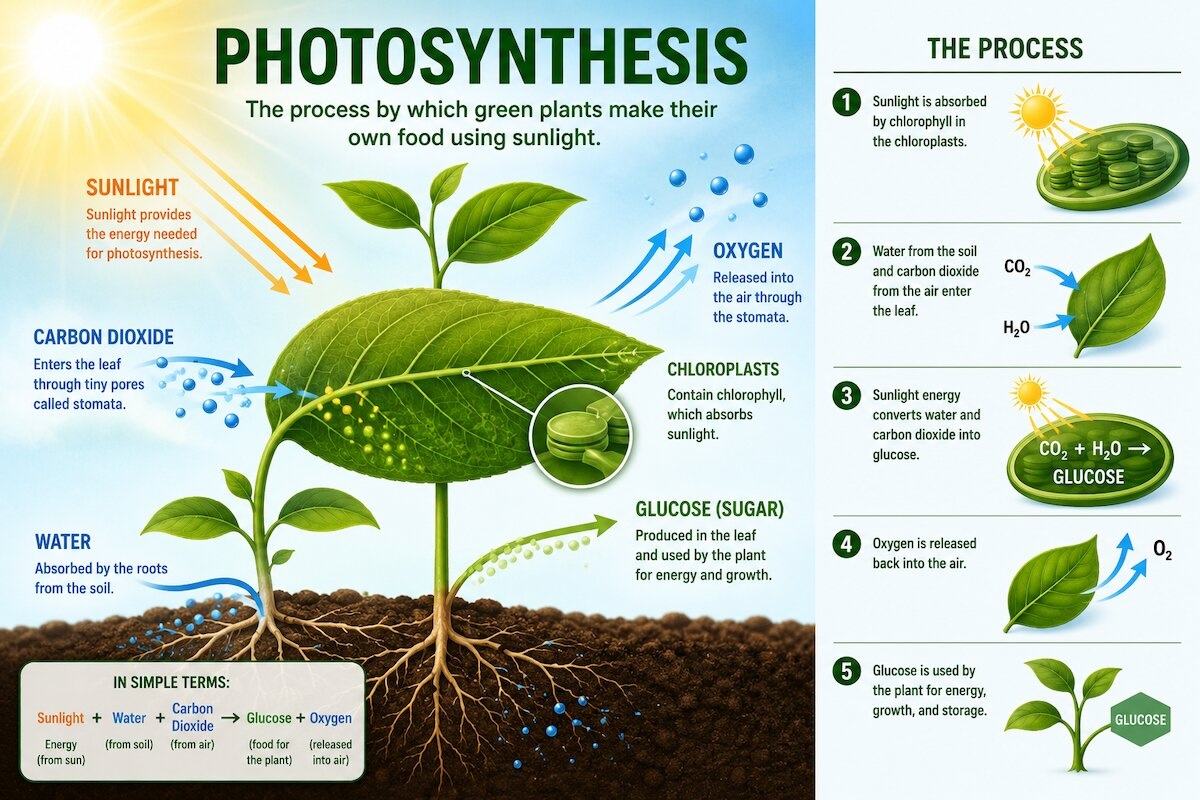
This fascinating process primarily occurs in plant leaves, specifically within tiny structures called chloroplasts. Chloroplasts contain chlorophyll, the green pigment responsible for capturing sunlight and initiating the process of food production. Photosynthesis takes place in two major phases: the light-dependent reactions and the light-independent reactions, also known as the Calvin Cycle. Together, these phases transform water and carbon dioxide into glucose, the plant’s primary source of energy.
What Is Photosynthesis?
Photosynthesis is the biological process by which plants use sunlight, water, and carbon dioxide to produce glucose (a simple sugar) and oxygen. Glucose serves as a fuel that supports growth, reproduction, and other life processes, while oxygen is released into the atmosphere as a valuable byproduct.
The overall chemical equation for photosynthesis is:
6CO₂ + 6H₂O + Light Energy -> C₆H₁₂O₆ + 6O₂
In simple terms:
- Carbon dioxide is absorbed from the air through tiny pores called stomata.
- Water is absorbed by the roots from the soil.
- Sunlight provides the energy needed for the reactions.
- Glucose is produced from food.
- Oxygen is released into the atmosphere.
Where Photosynthesis Takes Place
Photosynthesis occurs inside chloroplasts, which are found mainly in the cells of plant leaves. Chloroplasts contain chlorophyll, a green pigment that absorbs blue and red wavelengths of sunlight while reflecting green light, giving plants their characteristic color.
The chloroplast has two important structures:
- Thylakoid membranes – where the light-dependent reactions occur.
- Stroma – the fluid-filled space where the Calvin Cycle takes place.
The Two Main Phases of Photosynthesis
Phase 1: Light-Dependent Reactions
The first stage of photosynthesis is known as the light-dependent reactions, which require direct sunlight.
Where It Happens
These reactions occur within the thylakoid membranes of the chloroplast.
What Happens During This Phase?
When sunlight strikes chlorophyll molecules, electrons become energized. This energy powers a series of chemical reactions that ultimately convert solar energy into chemical energy.
During this phase:
- Chlorophyll absorbs sunlight.
- Water molecules are split into hydrogen ions, electrons, and oxygen.
- Oxygen is released into the atmosphere.
- ATP (adenosine triphosphate) and NADPH are produced as energy-rich molecules.
Inputs
- Sunlight
- Water (H₂O)
Outputs
- Oxygen (O₂)
- ATP
- NADPH
Importance
The ATP and NADPH produced during this phase serve as the energy source for the second phase of photosynthesis.
Phase 2: Light-Independent Reactions (Calvin Cycle)
The second phase is called the Calvin Cycle, or light-independent reactions. Although sunlight is not directly required at this stage, the ATP and NADPH produced during the light-dependent reactions are still required.
Where It Happens
The Calvin Cycle occurs in the stroma of the chloroplast.
What Happens During This Phase?
The Calvin Cycle uses atmospheric carbon dioxide and the energy stored in ATP and NADPH to produce glucose.
The process involves three primary steps:
1. Carbon Fixation
Carbon dioxide enters the leaf through the stomata and is captured by an enzyme called RuBisCO. The carbon atoms are attached to an existing five-carbon molecule.
2. Reduction
Using ATP and NADPH, the captured carbon molecules are converted into glyceraldehyde-3-phosphate (G3P), a three-carbon sugar.
3. Regeneration
Most of the G3P molecules are recycled to regenerate the original carbon-accepting molecule, allowing the cycle to continue. Some G3P molecules are used to produce glucose.
Inputs
- Carbon dioxide (CO₂)
- ATP
- NADPH
Outputs
- Glucose
- ADP
- NADP⁺
Why Glucose Is Important
The glucose produced during photosynthesis is essential for plant survival. Plants use glucose to:
- Produce energy through cellular respiration.
- Build cellulose for cell walls.
- Store excess energy as starch.
- Create fruits, seeds, flowers, and roots.
- Manufacture proteins and fats with additional nutrients.
Humans and animals also depend on this glucose, either by eating plants directly or by consuming animals that feed on plants.
Factors That Affect Photosynthesis
Several environmental conditions influence the rate of photosynthesis.
Light Intensity
More sunlight generally increases photosynthesis until the plant reaches its maximum capacity.
Carbon Dioxide Concentration
Higher levels of carbon dioxide can increase the rate of photosynthesis, provided other conditions remain favorable.
Temperature
Photosynthesis works best within an optimal temperature range. Extremely low temperatures slow enzyme activity, while excessively high temperatures can damage enzymes involved in the process.
Water Availability
Water shortages cause plants to close their stomata, reducing carbon dioxide intake and slowing photosynthesis.
Chlorophyll Content
Healthy leaves with abundant chlorophyll absorb sunlight more efficiently, leading to greater food production.
Why Photosynthesis Matters
Photosynthesis is essential not only for plants but for all life on Earth. Its importance includes:
- Producing oxygen needed by most living organisms.
- Forming the foundation of nearly every food chain.
- Removing carbon dioxide from the atmosphere.
- Helping regulate Earth’s climate.
- Supporting agriculture and global food production.
- Providing raw materials for biofuels and renewable energy.
Without photosynthesis, ecosystems would collapse, atmospheric oxygen would decline, and life as we know it would not exist.
Photosynthesis vs. Cellular Respiration
Although closely related, photosynthesis and cellular respiration are opposite processes.
| Photosynthesis | Cellular Respiration |
|---|---|
| Occurs in chloroplasts | Occurs in mitochondria |
| Requires sunlight | Does not require sunlight |
| Produces glucose | Breaks down glucose |
| Releases oxygen | Uses oxygen |
| Stores energy | Releases energy (ATP) |
Together, these processes create a continuous cycle of energy and matter that sustains life.
Interesting Facts About Photosynthesis
- Plants convert only a small percentage of available sunlight into stored chemical energy, yet it is sufficient to sustain most life on Earth.
- Marine algae and microscopic phytoplankton produce a significant share of the world’s oxygen through photosynthesis.
- Leaves appear green because chlorophyll reflects green wavelengths while absorbing mainly red and blue light.
- Evergreen plants continue to photosynthesize during cooler seasons, whenever environmental conditions allow.
- Scientists study photosynthesis to develop more efficient crops and renewable energy technologies inspired by nature.
Conclusion
Photosynthesis is an extraordinary natural process that enables plants to produce their own food using sunlight, water, and carbon dioxide. Through its two interconnected phases—the light-dependent reactions and the Calvin Cycle—plants transform solar energy into glucose while releasing oxygen that supports nearly all life on Earth. Beyond sustaining plant growth, photosynthesis drives global food chains, regulates atmospheric carbon dioxide, and maintains the oxygen-rich environment essential for humans and animals. Understanding how photosynthesis works not only deepens our appreciation of plant biology but also highlights the vital role plants play in preserving healthy ecosystems and supporting life on our planet.
Follow us on Facebook and Twitter.
Read: Biography Of Melchora Aquino aka Tandang Sora