Markus Castro
Bacon, Ham and Hot Dogs Are Group 1 Carcinogens: What the WHO Cancer Warning Really Means
Table of Contents
Bacon, ham, sausages, salami, hot dogs and other processed meats are classified as Group 1 carcinogens, meaning there is sufficient scientific evidence that consuming processed meat can cause cancer in humans.
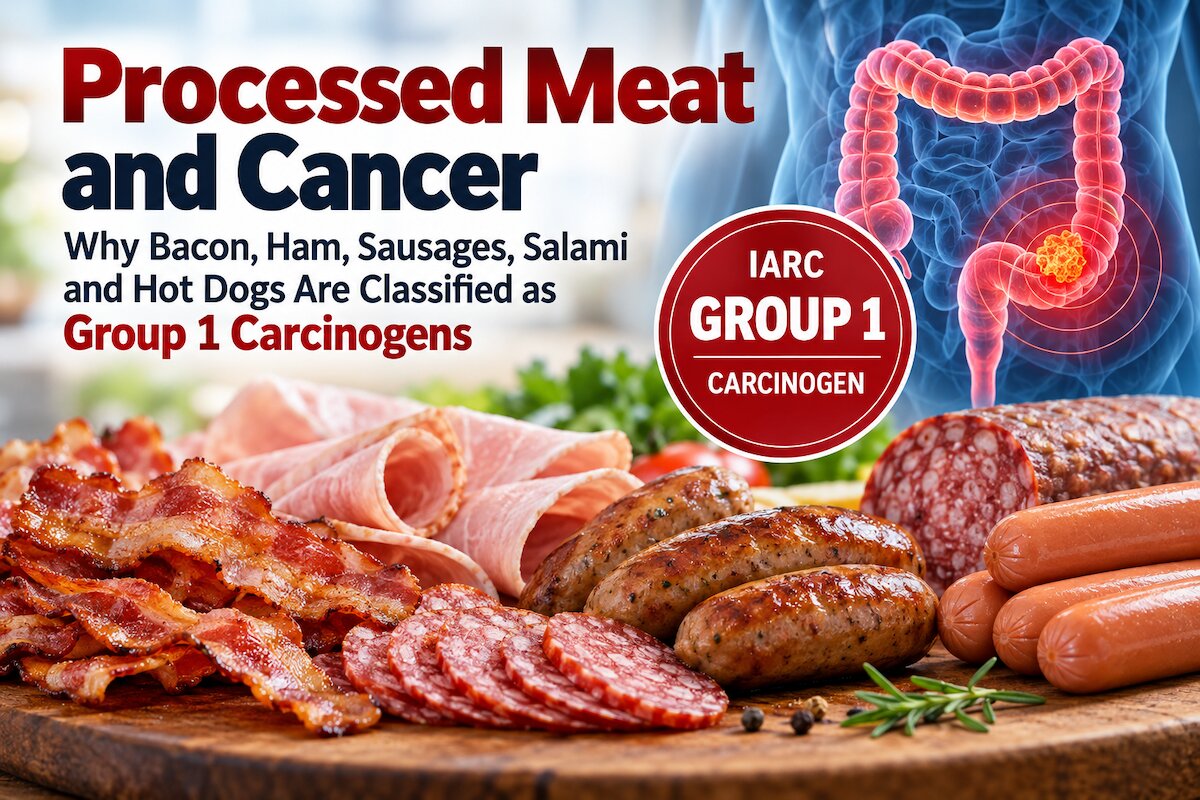
The International Agency for Research on Cancer (IARC), the World Health Organization’s (WHO) cancer research agency, announced this classification on 26 October 2015 after reviewing scientific evidence from studies worldwide.
The strongest evidence links processed meat consumption to colorectal cancer, which affects the colon or rectum. Research also suggests a possible association with stomach cancer, although the evidence is not sufficient to establish a definitive causal relationship for that cancer.
The classification remains important in 2026. In its September 2026 update on the carcinogenicity of red and processed meat, WHO reiterates the evidence linking processed meat consumption to colorectal cancer.
The finding deserves attention, but it should not create unnecessary fear. The classification describes how strong the evidence is that a substance can cause cancer. It does not mean that eating a slice of bacon or an occasional hot dog will cause cancer.
Key Takeaways
- Processed meats are classified as Group 1 carcinogens because scientific evidence establishes that they can cause cancer in humans.
- Colorectal cancer is the cancer most strongly associated with processed meat consumption.
- Eating 50 grams of processed meat daily is associated with an approximately 18% higher relative risk of colorectal cancer.
- Group 1 describes the strength of evidence, not the size of the risk compared with other Group 1 agents.
- Health organisations recommend limiting or avoiding processed meats as part of a cancer-prevention strategy.
- Beans, lentils, tofu, fish, eggs and other nutritious protein sources can replace processed meats in everyday meals.
- A balanced diet, physical activity, avoiding tobacco and appropriate cancer screening all contribute to cancer prevention.
What Are Processed Meats?
Processed meat refers to meat transformed through salting, curing, fermentation, smoking, or other preservation methods. Manufacturers use these processes to extend shelf life, change texture, improve flavour or preserve the product.
According to the WHO and IARC, common examples include:
- Bacon: Pork that has been cured and sometimes smoked.
- Ham: Meat that has been cured, salted or otherwise preserved.
- Sausages: Products that may contain cured or preserved meat, including frankfurters and chorizo.
- Salami: Cured and fermented meat, commonly made from pork or beef.
- Hot dogs: Frankfurters made from processed meat.
- Other examples: Corned beef, beef jerky, pepperoni, canned meat, and many deli meats.
The definition depends on how the meat is processed, not simply whether it comes from an animal. Some preserved poultry products can also qualify as processed meat. A fresh, uncured sausage may not fall into the same category, depending on how it is prepared and preserved.
Processed Meat Versus Ultra-Processed Food
Processed meat and ultra-processed food are different categories.
Processed meat is defined by the methods used to preserve or transform meat. Ultra-processed food is a broader category that generally refers to industrial formulations that use ingredients and additives to create or enhance a product.
Some products belong to both categories, but not all processed foods are processed meats, and not all processed meats are necessarily classified as ultra-processed under every food classification system.
The cancer evidence on processed meat should therefore be discussed on its own terms rather than automatically applied to every packaged or industrially manufactured food.
Why Did IARC Classify Processed Meat as a Group 1 Carcinogen?
In October 2015, an IARC working group of 22 experts from 10 countries evaluated the available evidence on red and processed meat consumption.
The review considered more than 800 studies examining meat consumption and cancer in different populations. The researchers found sufficient evidence that processed meat consumption causes colorectal cancer in humans.
IARC consequently placed processed meat in Group 1, the category used for agents with sufficient evidence of carcinogenicity in humans.
The decision attracted international attention because many of the foods involved are common breakfast staples, sandwich fillings and convenient meal options.
However, IARC’s role is to evaluate whether an exposure can cause cancer. It does not independently determine the ideal amount of a food that everyone should consume. Dietary recommendations require consideration of the evidence, potential benefits, overall nutrition and public health priorities.
What Does Group 1 Carcinogen Actually Mean?
Distinguishing hazard from risk is essential to understanding the classification.
A hazard is something that can cause harm under certain conditions. Risk describes the likelihood of that harm occurring at a given level of exposure.
Group 1 means that sufficient evidence establishes that processed meat can cause cancer. It does not mean every Group 1 agent carries the same level of danger.
Tobacco smoking and asbestos are also classified as Group 1 carcinogens, but this does not mean processed meat presents the same magnitude of risk as smoking or asbestos exposure.
The classification is about the strength of the evidence, not a ranking of how dangerous each agent is.
For processed meat, the evidence indicates that cancer risk increases with consumption. When interpreting the findings, the amount eaten and the frequency of consumption matter.
How Much Does Processed Meat Increase Cancer Risk?
The WHO and IARC estimate that consuming 50 grams of processed meat every day is associated with an approximately 18% increase in the relative risk of colorectal cancer.
This estimate comes from an analysis of 10 studies reviewed during the original assessment.
What Does 18% Higher Relative Risk Mean?
Relative risk compares the risk between two groups. An 18% increase does not mean that 18 out of every 100 people who eat processed meat will develop colorectal cancer.
Consider a hypothetical population where 10 out of 1,000 people develop a particular cancer over a defined period. An 18% relative increase would raise that figure to approximately 11.8 out of 1,000, assuming the same baseline risk and other conditions.
That is an absolute increase of about 1.8 cases per 1,000 people, not 18 additional cases per 100 people.
This example illustrates how relative risk is calculated. It is not an estimate of an individual’s actual colorectal cancer risk, which depends on age, family history, lifestyle, genetics and other factors.
What Does 50 Grams Look Like?
Fifty grams is a relatively small portion of meat. Depending on thickness and product type, it might represent a few slices of bacon, several slices of deli ham, or a portion of another processed meat.
The exact number of slices or pieces varies considerably. Weighing a serving provides a more accurate estimate than counting slices.
The statistic concerns regular daily consumption. It should not be interpreted as evidence that one 50-gram serving causes cancer or that occasional consumption carries the same risk as eating processed meat every day.
Scientists have not established a universally safe consumption threshold below which colorectal cancer risk does not increase. The World Cancer Research Fund therefore recommends consuming very little, if any, processed meat.
How Can Processed Meat Contribute to Cancer?
Researchers are investigating several biological mechanisms that may explain the relationship between processed meat and colorectal cancer.
1. Curing and Preservatives
Some processed meats contain nitrites or nitrates used in preservation. Under certain conditions, these substances can form N-nitroso compounds, some of which can damage DNA and contribute to cancer development.
However, the relationship is more complex than the presence of one ingredient. The food’s composition, processing conditions, and the body’s chemistry can all influence the formation of potentially harmful compounds.
2. Heme Iron and N-Nitroso Compounds
Heme iron, which occurs naturally in meat, may promote the formation of compounds that damage the intestinal lining. Processed meats can also contain compounds formed during preservation.
These mechanisms plausibly explain the observed association between processed meat consumption and colorectal cancer. Scientists continue to investigate how these processes interact in the human body.
3. Smoking and High-Temperature Cooking
Smoking meat can introduce additional chemical compounds. Cooking meat at high temperatures, particularly over an open flame or until heavily charred, can also produce heterocyclic amines and polycyclic aromatic hydrocarbons.
The US National Cancer Institute explains how these compounds form during cooking and discusses research into their potential health effects.
Changing cooking methods may reduce exposure to some cooking-related compounds, but it does not necessarily remove the risks associated with the processed meat itself.
Processed Meat Versus Red Meat: What Is the Difference?
Processed meat and red meat have different IARC classifications.
| Category | IARC classification | What the evidence means |
|---|---|---|
| Processed meat | Group 1, carcinogenic to humans | Sufficient evidence that it causes cancer in humans, particularly colorectal cancer |
| Red meat | Group 2A, probably carcinogenic to humans | Evidence suggests a causal relationship, but it is less conclusive than the evidence for processed meat |
Red meat refers to the muscle meat of mammals, including beef, pork, lamb, goat and veal. Fresh, unprocessed red meat is not automatically classified as processed meat.
The World Cancer Research Fund recommends limiting red meat to moderate amounts and consuming very little, if any, processed meat.
This distinction matters because the evidence strength differs between the two categories. It does not mean that all red meat carries the same cancer risk as processed meat.
What Do Major Health Organisations Recommend?
Health organisations generally encourage dietary patterns that reduce established cancer risks while maintaining adequate nutrition.
World Health Organization: WHO identifies high processed meat consumption as a colorectal cancer risk factor. Its broader healthy-diet guidance encourages a varied diet based on nutritious foods, including fruits, vegetables, legumes and whole grains. WHO’s September 2026 update notes that it is developing guidance on optimal intake of animal-source foods, including red and processed meat.
International Agency for Research on Cancer: IARC evaluates the evidence on whether exposures can cause cancer. Its classification provides the scientific foundation for public health discussions but does not prescribe a universal serving limit.
World Cancer Research Fund: The organisation recommends consuming very little, if any, processed meat and limiting red meat. It also encourages diets rich in whole grains, vegetables, fruits and beans.
European Code Against Cancer: The IARC-supported code advises people to avoid processed meat and limit red meat as part of cancer prevention.
These recommendations broadly encourage lower processed meat consumption, although wording and implementation differ between organisations and countries.
How to Read Processed Meat Labels
Food labels can help consumers identify products that contain processed meat, but marketing terminology can be confusing.
Check the Ingredient List
Look for ingredients and product descriptions associated with curing, smoking, fermentation and preservation. Examples include nitrites, nitrates, curing salts, and certain preserved-meat ingredients.
The presence or absence of one ingredient does not establish whether a product carries zero cancer risk. The classification concerns the processed meat and the available evidence about its consumption.
Understand “Uncured” and “Natural”
Terms such as “natural,” “uncured,” and “nitrate-free” can mean different things depending on national food regulations and the product’s formulation.
In some markets, a product marketed as “uncured” may use vegetable ingredients, such as celery powder, that naturally contain nitrate. This does not automatically mean that the product is equivalent to fresh, unprocessed meat.
Read the full ingredient list and the product description rather than relying on the front-of-package claim alone.
Compare Sodium and Saturated Fat
Processed meats can contain substantial amounts of sodium and, depending on the product, saturated fat. Comparing nutrition labels can help consumers choose products that better fit their overall dietary needs.
However, a product with less sodium or saturated fat is not necessarily free from the cancer-related concerns associated with processed meat.
Healthier Alternatives to Processed Meat
Reducing processed meat does not mean eliminating protein or following an unnecessarily restrictive diet.
| Processed meat | Practical alternative | Why it can help |
|---|---|---|
| Bacon | Eggs, beans or tofu | Provides protein without relying on cured meat |
| Ham | Freshly prepared chicken or fish | Offers an alternative protein source when prepared without curing |
| Sausages | Lentil patties, beans or fresh poultry | Adds variety and can increase fibre intake when plant-based foods are used |
| Salami | Hummus, chickpeas or egg | Works well in sandwiches and wraps |
| Hot dogs | Bean burgers, grilled fish or tofu | Provides alternatives for family meals and barbecues |
| Deli meat | Leftover cooked chicken, tuna or mashed beans | Offers practical sandwich fillings |
Plant-based bacon, sausages and burgers can also help people reduce processed meat consumption. However, their nutritional quality varies. Some products contain considerable sodium or saturated fat, so compare labels and choose products that suit your dietary needs.
Whole foods such as beans, lentils, chickpeas and tofu can be particularly useful because they provide protein and, in many cases, dietary fibre.
A Sample One-Day Meal Plan Without Processed Meat
This example shows how readers can replace processed meats while maintaining a varied diet.
Breakfast: Scrambled eggs with wholegrain toast, tomatoes and fruit.
Lunch: A chickpea and vegetable salad with wholegrain bread, or a sandwich filled with freshly cooked chicken, lettuce and tomatoes.
Afternoon snack: Plain yoghurt, fruit or a small handful of unsalted nuts.
Dinner: Baked fish or tofu with brown rice, steamed vegetables and beans.
Optional snack: Carrot sticks with hummus or a piece of fruit.
This plan is illustrative, not a personalised prescription. Portion sizes and nutritional needs vary by age, activity level, health status, and individual requirements.
What About Children and Teenagers?
Families can reduce processed meat consumption without compromising children’s growth or nutritional needs.
For school lunches, parents can rotate fillings such as egg, chicken, tuna, hummus and mashed beans instead of relying on ham or salami every day. Breakfast can include eggs, oats, yoghurt or other nutritious foods that suit the family’s budget and food culture.
Children need adequate protein, iron, vitamin B12 and other nutrients for growth. Families should focus on varied, balanced meals rather than imposing restrictive diets based on fear of cancer.
The practical goal is to build eating habits that include a range of nutritious foods and rely less on processed meats.
Processed Meat and Cancer Prevention: The Bigger Picture
Processed meat consumption is one factor among several that influence colorectal cancer risk. Reducing it can support a broader prevention strategy, but it cannot eliminate cancer risk on its own.
WHO estimates that approximately 1.9 million new colorectal cancer cases and more than 900,000 deaths occurred worldwide in 2022. The disease is a major global public health concern.
According to WHO’s February 2026 colorectal cancer fact sheet, risk factors include high processed and red meat intake, low fruit and vegetable intake, physical inactivity, overweight and obesity, tobacco use, alcohol consumption, older age and family history.
Evidence-based prevention measures include:
- Eating a varied diet rich in whole grains, vegetables, fruits and legumes.
- Limiting processed meat and moderating red meat consumption.
- Maintaining regular physical activity and a healthy body weight.
- Avoiding tobacco and limiting alcohol consumption.
- Following appropriate colorectal cancer screening recommendations.
Fibre-rich foods are particularly useful in a healthy dietary pattern. They can support bowel health and help replace high-sodium foods or processed meats.
Colorectal Cancer Screening: Why Guidelines Differ
Screening can identify colorectal cancer before symptoms appear. Some screening tests can also detect precancerous polyps that healthcare professionals can remove.
Recommendations vary between countries. For example, the American Cancer Society recommends that adults at average risk begin regular colorectal cancer screening at age 45. In England, the NHS bowel cancer screening programme invites eligible adults aged 50 to 74 to complete a home screening test every two years.
These are examples of national programmes, not universal rules. Readers should follow the recommendations in their own country and discuss earlier or more frequent screening with a healthcare professional if they have a family history of colorectal cancer, inherited risk conditions, certain intestinal diseases or a personal history of colorectal polyps.
Do not wait for a routine screening invitation if you have persistent changes in bowel habits, blood in your stool, unexplained weight loss or other concerning symptoms. Contact a healthcare professional for assessment.
Myth Versus Fact: Processed Meat and Cancer
Myth: Group 1 means processed meat is as dangerous as smoking.
Fact: Group 1 describes the strength of evidence that an agent can cause cancer. It does not mean that processed meat and tobacco carry identical levels of risk.
Myth: Eating processed meat once means you will develop cancer.
Fact: Cancer risk depends on many factors, including the amount and frequency of exposure, age, genetics and other lifestyle factors. The evidence does not suggest that one serving guarantees cancer.
Myth: Uncured or natural bacon is automatically safe.
Fact: Marketing claims do not necessarily mean a product is unprocessed. Some products use alternative nitrate sources or other preservation methods. Check the ingredients and understand the processing used.
Myth: Grilling processed meat removes the cancer risk.
Fact: Cooking methods can affect the formation of certain compounds, but grilling, frying or boiling does not change the fact that a cured or otherwise preserved meat remains processed meat.
Myth: Avoiding processed meat eliminates colorectal cancer risk.
Fact: Reducing processed meat can help lower one established dietary risk, but colorectal cancer also involves age, family history, lifestyle, genetics and other factors. Screening and broader preventive measures remain important.
Practical Checklist: How to Reduce Processed Meat Consumption
- Check how often you eat bacon, ham, sausages, salami and hot dogs.
- Replace one or more regular servings with beans, lentils, eggs, tofu, fish or freshly prepared poultry.
- Read ingredient lists instead of relying solely on “natural,” “uncured” or “nitrate-free” claims.
- Compare sodium and saturated fat levels when choosing packaged foods.
- Add whole grains, vegetables, fruit and legumes to everyday meals.
- Choose varied protein sources rather than relying on one food category.
- Ask a healthcare professional about colorectal cancer screening if you are eligible or have increased risk factors.
- Seek medical advice if you experience persistent bowel changes, blood in your stool or unexplained weight loss.
What Scientists Still Do Not Know
Although the evidence linking processed meat to colorectal cancer is established, important research questions remain.
Scientists continue to investigate how different processing methods, meat compositions, preservation ingredients and cooking practices influence cancer risk. Researchers also study how dietary patterns interact with genetics, gut biology and other lifestyle factors.
Population studies can identify associations and support causal conclusions, but they cannot predict an individual’s exact cancer risk from a particular food or serving. Researchers also cannot establish a universally safe consumption threshold from the available evidence.
These uncertainties do not negate the Group 1 classification. They explain why public health recommendations focus on reducing exposure and improving overall dietary patterns rather than promising that one specific serving limit guarantees safety.
Conclusion: Make Informed Food Choices
The Group 1 classification of processed meat reflects strong scientific evidence that these products can cause cancer in humans, particularly colorectal cancer. This is a reason to pay attention to regular consumption, not to panic about an occasional meal.
Readers can take practical steps by reducing processed meat in everyday meals, choosing varied protein sources, eating more fibre-rich foods and following appropriate screening recommendations. Families can make these changes gradually without sacrificing balanced nutrition or familiar food traditions.
Cancer prevention involves many factors, and no single dietary change guarantees protection. Informed food choices, regular physical activity, avoiding tobacco, and seeking timely medical advice can all support better long-term health.
Frequently Asked Questions
1. Why are bacon, ham, sausages, salami and hot dogs classified as Group 1 carcinogens?
The IARC classified processed meat as Group 1 in 2015 after reviewing scientific studies that provided sufficient evidence that processed meat consumption causes cancer in humans. The strongest evidence concerns colorectal cancer. The classification applies to processed meat as defined by methods such as curing, smoking, salting and fermentation. It describes the strength of the scientific evidence, not the risk from a single serving.
2. Does eating processed meat mean I will get cancer?
No. Eating processed meat does not mean that a person will inevitably develop cancer. The research indicates that regular consumption increases colorectal cancer risk, with higher consumption generally associated with higher risk. Individual risk also depends on factors such as age, genetics, family history, physical activity, and other dietary habits. Reducing processed meat is a sensible preventive measure, but it cannot guarantee you will never develop cancer.
3. How much processed meat is associated with an increased cancer risk?
The WHO and IARC estimate that eating 50 grams of processed meat daily is associated with an approximately 18% increase in relative colorectal cancer risk. This is a population-level estimate based on research, not a prediction for every individual. The amount represented by 50 grams varies by product and serving size. Researchers have not established a universally safe threshold below which there is no increased risk.
4. Is red meat also a Group 1 carcinogen?
No. IARC classifies processed meat as Group 1, carcinogenic to humans, and red meat as Group 2A, probably carcinogenic to humans. Red meat includes fresh beef, pork, lamb and other mammalian muscle meat. Processed meat is defined as meat that has undergone preservation or transformation methods. Both categories have evidence linking them to colorectal cancer, but the evidence supporting the processed meat classification is stronger.
5. Are uncured or nitrate-free processed meats safer?
Not necessarily. Terms such as “uncured,” “natural,” and “nitrate-free” can have specific meanings under national food labelling regulations. Some products use alternative ingredients, including vegetable powders containing naturally occurring nitrates, or rely on other preservation methods. These claims do not automatically mean that a product is equivalent to fresh, unprocessed meat. Consumers should read the ingredient list and consider the overall processing method.
6. Are plant-based bacon and sausages healthier alternatives?
Plant-based meat substitutes can help reduce processed meat consumption, but their nutritional quality varies. Some contain high levels of sodium or saturated fat, while others provide useful protein and fibre. Whole-food alternatives such as beans, lentils, chickpeas and tofu can offer additional nutritional benefits. Compare ingredient lists and nutrition labels rather than assuming every plant-based product is automatically healthy. A varied diet is generally more useful than relying heavily on any single substitute.
7. Can grilling, frying or boiling processed meat remove its cancer risk?
No cooking method has been shown to eliminate the cancer-related concerns associated with processed meat. High-temperature cooking, particularly grilling over an open flame or heavily charring meat, can produce additional compounds such as heterocyclic amines and polycyclic aromatic hydrocarbons. Cooking gently and avoiding charring can reduce exposure to some of these compounds. However, changing the cooking method does not turn cured or preserved meat into unprocessed meat.
8. Should children avoid bacon, ham and hot dogs completely?
Families should avoid making processed meat a major part of children’s everyday diets, but they do not need to respond with fear or restrictive eating. Parents can offer varied meals that include eggs, beans, fish, chicken, tofu, vegetables and whole grains. Children’s nutritional needs change as they grow, so balanced meals remain essential. Parents with concerns about nutrition, growth, or dietary restrictions can consult a qualified healthcare professional for guidance tailored to their child.
9. When should adults start colorectal cancer screening?
Screening recommendations differ by country and individual risk. The American Cancer Society recommends regular screening from age 45 for adults at average risk. England’s NHS programme invites eligible adults aged 50 to 74 for screening every two years. These examples should not replace local guidance. People with a strong family history, inherited conditions or other risk factors may need earlier screening. Anyone with concerning symptoms should seek medical assessment rather than wait for a routine screening appointment.
10. What foods can replace processed meat in everyday meals?
Useful alternatives include eggs, freshly prepared poultry, fish, beans, lentils, chickpeas, tofu and other nutritious protein sources. For breakfast, try eggs or beans instead of bacon. For sandwiches, consider hummus, chickpeas, freshly cooked chicken or tuna. For dinner, use lentils, tofu, or fish instead of sausages or hot dogs. Pair these foods with vegetables and whole grains to support a varied diet. Choose alternatives that fit your nutritional needs, food preferences and budget.
11. Does avoiding processed meat prevent colorectal cancer?
Avoiding or reducing processed meat can lower one established dietary risk, but it does not eliminate colorectal cancer risk. Other factors include age, family history, inherited conditions, physical activity, body weight, tobacco use and alcohol consumption. A balanced diet rich in whole grains, vegetables, fruits and legumes can support prevention efforts. Following appropriate screening guidance is also important because screening may detect cancer early or identify precancerous polyps before they develop into cancer.
12. Where can readers find reliable information about processed meat and cancer?
The most useful starting points are official resources from the World Health Organization, the International Agency for Research on Cancer, the World Cancer Research Fund, and national cancer organisations. These sources explain scientific classifications, risk estimates, dietary recommendations, and screening guidance. Readers should be cautious about headlines that confuse relative risk with absolute risk or imply that one serving guarantees cancer. For personal dietary or screening advice, consult a qualified healthcare professional.
Medical Disclaimer: This article is for general educational purposes and does not replace individual medical advice, diagnosis, or treatment. Consult a qualified healthcare professional about your dietary needs, cancer risk factors, symptoms and screening options.
Follow us on Facebook and Twitter.
Read:
- Diabetes and Filipino Street Food: What to Choose and What to Limit
- Walking for Diabetes: How Many Steps Should You Aim For?
- How to Reverse Prediabetes Through Healthy Filipino Lifestyle Habits
- Early Warning Signs of Diabetes Filipinos Should Never Ignore
- Ozempic Price in the Philippines 2026: Cost, Dosage and Prescription Guide