

 Markus Castro
How to Prepare for the Big One in Metro Manila: An Earthquake Preparedness Guide
Table of Contents
A major earthquake in Metro Manila could disrupt transportation, electricity, water supplies, telecommunications, and essential services across the National Capital Region. Residents should prepare for strong ground shaking, falling debris, damaged buildings, aftershocks, and possible difficulty accessing food, medicine, and emergency assistance.
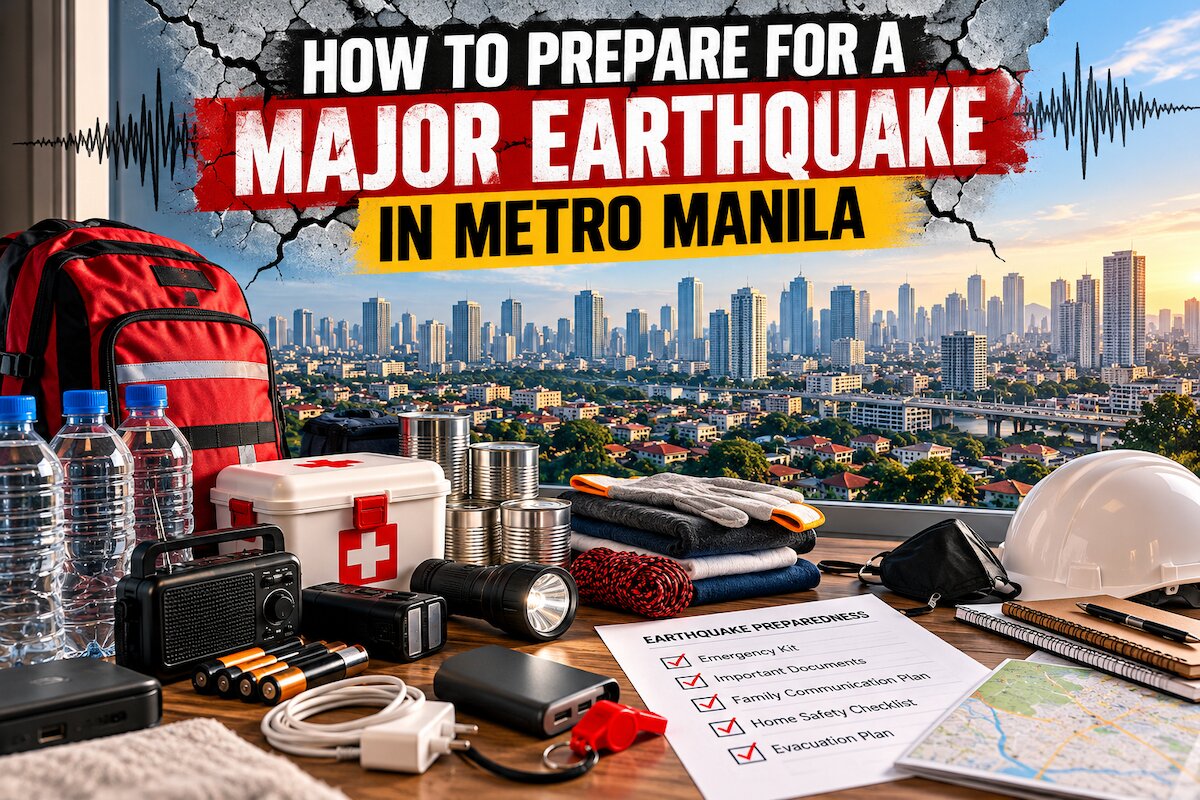
The West Valley Fault, part of the Valley Fault System, presents a significant earthquake hazard to Metro Manila and nearby provinces. Scientists have identified the fault system as a potential source of a destructive earthquake, commonly referred to as the “Big One.” However, no agency can reliably predict when a major earthquake will occur.
Preparing for this possibility requires more than keeping an emergency bag at home. Families need to understand their local hazards, secure their living spaces, establish communication plans, identify evacuation areas, and learn what to do before, during, and after an earthquake.
This guide explains how Metro Manila residents can prepare for a major earthquake using practical measures and official information from the Philippine Institute of Volcanology and Seismology (PHIVOLCS) and other government agencies.
Understanding the Big One and the West Valley Fault
The “Big One” is a commonly used term for a potential major earthquake associated with movement along the West Valley Fault. The fault forms part of the Valley Fault System, which includes the West Valley Fault and East Valley Fault.
The West Valley Fault extends through parts of the Greater Metro Manila Area and nearby provinces. PHIVOLCS has mapped the fault to help communities, property owners, local governments, and planners understand where active fault traces occur.
A major earthquake could cause several hazards, depending on its magnitude, depth, distance from affected communities, ground conditions, and the strength of buildings and infrastructure.
These hazards include:
- Ground shaking: Strong movement that can damage buildings, bridges, roads, and utilities.
- Ground rupture: Permanent ground displacement when an active fault breaks through the surface.
- Liquefaction: A process in which water-saturated, loose soil loses strength during intense shaking.
- Landslides: Slope failures that may occur in susceptible areas.
- Falling debris: Broken glass, unsecured furniture, ceiling materials, and other objects that can injure people.
- Service disruptions: Interruptions to electricity, water, mobile networks, transport, and other essential services.
Not every community will experience the same level of damage. Even neighborhoods far from the mapped fault trace can experience strong shaking. Building safety, soil conditions, and preparedness all influence the consequences.
Earthquake preparedness should therefore be a priority throughout Metro Manila, not only for households near the West Valley Fault.
Which Metro Manila Areas Should Prepare for the West Valley Fault?
Metro Manila consists of 16 cities and one municipality. All should maintain earthquake preparedness plans, but residents must distinguish between areas exposed to earthquake shaking and properties located directly along an active fault trace.
The 16 cities are Manila, Quezon City, Caloocan, Las Piñas, Makati, Malabon, Mandaluyong, Marikina, Muntinlupa, Navotas, Parañaque, Pasay, Pasig, San Juan, Taguig, and Valenzuela. The sole municipality is Pateros.
The West Valley Fault crosses portions of the Greater Metro Manila Area. Its precise location relative to an individual property matters, so don’t assume every barangay or neighborhood within a listed city lies directly on the fault.
How to Check Your Property’s Earthquake Hazard
- Use PHIVOLCS FaultFinder
Visit the PHIVOLCS FaultFinder to investigate the nearest mapped active fault and its distance from a selected location. The tool also provides information about the mapped fault segment and mapping scale.
- Consult official earthquake hazard maps
Visit the PHIVOLCS Maps Portal and look for relevant earthquake hazard information. Check ground-shaking, ground-rupture, liquefaction, and other applicable hazard maps for your location.
- Contact your local government
Ask your barangay or city Disaster Risk Reduction and Management Office (DRRMO) about evacuation sites, local hazard assessments, emergency hotlines, and designated evacuation routes.
A digital map is a screening tool, not a structural safety certificate. If you are buying property, renovating a house, or assessing a building near an active fault, seek advice from qualified engineers and the appropriate government authorities. PHIVOLCS also advises users to consult the agency for official hazard assessments when necessary.
1. Create a Family Earthquake Emergency Plan
Every household should have an emergency plan that all members understand. This is especially important in Metro Manila, where family members may be separated at work, school, or during daily commutes when an earthquake occurs.
Start by discussing what each person should do if strong shaking begins. Identify safe spots inside your home, a meeting place outside your building, and a second meeting place away from your immediate neighborhood.
Establish Two Meeting Places
Choose two locations that everyone can find without relying on mobile data or GPS.
- Meeting place near home: An open area away from buildings, walls, electric posts, glass, and overhead hazards.
- Meeting place outside your neighborhood: A location where family members can reunite if roads become impassable or the immediate area becomes unsafe.
Check whether the locations are accessible and appropriate for people with disabilities, older adults, and young children. Do not automatically select a school, shopping mall, or public building without checking its emergency arrangements.
Prepare an Emergency Contact List
Write down important contact information and place copies in emergency bags, wallets, and other accessible locations.
Include the following:
- Names and mobile numbers of immediate family members.
- Contact details of relatives living outside Metro Manila.
- School and workplace emergency contacts.
- Barangay and city DRRMO contact numbers.
- Important medical information and emergency contacts for dependents.
- Your home, workplace, and designated meeting places.
Choose one relative or trusted contact outside the immediate area whom everyone can contact when local communication networks are disrupted. Text messages may sometimes get through when voice calls are difficult, but communication is not guaranteed.
Plan for Children, Older Adults, and Persons With Disabilities
Assign responsibilities before an emergency happens. Decide who will help young children, who will assist an older relative, and who will carry essential supplies.
Keep spare eyeglasses, hearing-aid batteries, mobility-device accessories, and other necessary items accessible. If a family member uses regular medication, prepare an appropriate supply and maintain an updated list of medicines and dosages.
Teach children how to identify trusted adults and explain what to do if they become separated from their caregivers. Use simple instructions and practice them during family earthquake drills.
2. Prepare an Earthquake Emergency Go-Bag
A go-bag contains essential supplies that you can carry if you must leave your home quickly. Keep it somewhere accessible, preferably near an exit but away from objects that could fall on it.
Prepare at least one bag per household, then adjust the contents based on the number of family members, medical needs, and the likely duration of the disruption.
Earthquake Emergency Kit Checklist
Use this checklist to prepare your supplies.
Water and food
- Drinking water for each household member.
- Ready-to-eat food, such as crackers, canned goods, and energy bars.
- Manual can opener and reusable utensils.
First aid and health
- First-aid kit and basic wound-care supplies.
- Prescription medicines and copies of prescriptions.
- Face masks, personal hygiene supplies, and sanitary products.
Communication and power
- Battery-powered or hand-crank radio.
- Flashlight and spare batteries.
- Fully charged power bank and charging cables.
- Whistle for signaling rescuers.
Documents and money
- Copies of IDs, emergency contacts, and important documents in waterproof packaging.
- Small-denomination cash.
- Emergency contact list on paper.
Clothing and practical supplies
- Extra clothes, underwear, and sturdy footwear.
- Lightweight blanket or emergency blanket.
- Work gloves, a basic multipurpose tool, and waterproof bags.
- Supplies for babies, older adults, pets, or persons with disabilities.
The go-bag should support your household’s immediate needs. For longer disruptions, keep extra supplies at home rather than trying to carry everything in one bag.
Store water and food safely, rotate them before expiry, and check batteries periodically. Keep emergency supplies away from excessive heat and moisture.
Do not forget pets. Prepare drinking water, pet food, a leash or carrier, waste bags, and copies of vaccination records. Identify pet-friendly temporary accommodation options before an emergency occurs.
3. Make Your Home Safer Before an Earthquake
Falling objects and unsecured furniture can cause serious injuries during strong shaking. Many practical safety improvements cost less than repairing damaged belongings or replacing broken appliances.
Secure Heavy Furniture and Appliances
Attach tall cabinets, bookshelves, and other heavy furniture to suitable wall anchors. Use appropriate restraints for televisions, refrigerators, and other appliances that could tip over.
Move heavy objects to lower shelves. Store glassware, breakable items, chemicals, and other hazardous materials where they are less likely to fall.
Secure hanging pictures, mirrors, decorative items, and ceiling fixtures. Avoid placing heavy objects above beds, sofas, and frequently used seating areas.
Identify Safe Spots in Every Room
Look for sturdy tables or desks that can provide protection from falling objects. Identify interior areas away from windows, glass doors, tall cabinets, and unsecured fixtures.
Keep hallways and exit routes clear. Do not block doors with storage boxes, shoes, or furniture. Ensure that household members can reach essential exits without navigating clutter.
Learn where the main electricity breaker, water shutoff, and gas supply controls are located, if applicable. Only turn utilities off when it is safe to do so, and do not attempt repairs to damaged gas or electrical systems without qualified assistance.
Check the Structural Safety of Your House
Cracks, water damage, corrosion, and previous unapproved renovations can affect building safety. However, a resident’s visual inspection cannot reliably determine whether a structure will withstand a major earthquake.
If you live in an older house, a structure with visible damage, or a building with questionable alterations, consult a licensed civil or structural engineer. Property owners should follow applicable building codes and seek professional assessments where necessary.
PHIVOLCS provides earthquake preparedness resources and a self-check tool called How Safe Is My House? for certain concrete hollow-block houses. Use these resources as an initial guide, not a substitute for a professional structural assessment.
4. Earthquake Preparedness for Condominium and High-Rise Residents
Condominium residents face additional challenges during a major earthquake. Elevators may become unavailable, stairs may become crowded, and building utilities or access controls may fail.
Before an earthquake, ask your building administrator about its emergency response plan. Know the designated evacuation routes, assembly area, alarm signals, and procedures for residents who need assistance.
What Condominium Residents Should Do
- Identify at least two possible stairway routes if the building provides them.
- Learn where the designated assembly area is located.
- Keep shoes, a flashlight, and essential supplies accessible.
- Secure cabinets, televisions, and heavy decorative objects inside the unit.
- Know how to contact building security and property management.
- Ask how the building assists children, older residents, and persons with disabilities during emergencies.
- Participate in building earthquake drills.
Do not use elevators during an earthquake or when the building must be evacuated. Follow building emergency instructions and use designated stairways when it is safe to move.
During strong shaking, do not run toward the stairs or attempt to exit a high-rise building immediately. Take cover where you are. Once the shaking stops, assess immediate dangers and follow the building’s evacuation instructions.
Do not return to your unit to retrieve belongings if authorities or building management have ordered an evacuation. Do not re-enter a building that appears damaged until qualified personnel have assessed it and authorized re-entry.
Building owners and administrators should maintain emergency procedures, communicate clearly with residents, and arrange regular drills. PHIVOLCS specifically emphasizes earthquake preparedness among high-rise building owners, occupants, and other stakeholders.
5. Learn What to Do During an Earthquake
The most important immediate action during strong shaking is to protect yourself from falling objects and debris.
Follow Drop, Cover, and Hold On
Drop: Get down on your hands and knees before the shaking knocks you over. Stay low and be ready to move toward nearby cover if needed.
Cover: Protect your head and neck. Crawl under a sturdy table or desk if one is nearby. If no suitable cover is available, get low beside an interior wall away from windows and cover your head and neck with your arms.
Hold On: Hold on to the table or desk and be ready to move with it. Keep your head and neck protected until the shaking stops.
PHIVOLCS recommends the Drop, Cover, and Hold procedure during strongly felt earthquakes.
If You Are at Home or in the Office
Stay indoors during the shaking. Keep away from windows, glass partitions, cabinets, and exterior walls that could shed debris. Do not run outside while objects may be falling from buildings.
If you are in bed, stay there and protect your head with a pillow unless you are directly beneath a heavy fixture or another obvious hazard. Keep shoes nearby for use after the shaking stops.
If You Are on the Street
Move away from buildings, glass façades, walls, streetlights, electric wires, and other objects that may fall. If you cannot reach a clear area safely during the shaking, crouch and protect your head and neck.
Do not approach damaged buildings to take photographs. Fallen power lines may remain energized, so stay well away and report them to the appropriate authorities.
If You Are Driving or Riding Public Transport
If you are driving, slow down carefully and stop in a safe location away from bridges, overpasses, buildings, trees, and power lines. Remain inside the vehicle until the shaking stops, unless staying there presents an immediate danger.
If you are on a bus or train, follow the operator’s instructions. Do not jump out of a moving vehicle or attempt to leave a train or station without authorization. If you are riding a motorcycle or bicycle, prioritize stopping safely and moving away from traffic and falling hazards when conditions permit.
If You Are Inside a Shopping Mall or Cinema
Stay away from glass storefronts, display shelves, hanging fixtures, and large decorative installations. Take cover and protect your head and neck.
Do not rush toward exits or escalators while the ground is shaking. Afterward, follow staff instructions and designated evacuation routes. Avoid using elevators and do not return for shopping bags or other belongings.
6. What to Do Immediately After an Earthquake
The danger does not necessarily end when the ground stops shaking. Aftershocks may cause further damage to already weakened buildings, while broken glass, fallen debris, damaged utilities, and blocked roads can create additional hazards.
Check Yourself and Others for Injuries
Check yourself first, then help household members and nearby people if you can safely do so. Provide basic first aid within your training and call for professional assistance when needed.
Do not move someone with a suspected spinal injury unless an immediate danger makes movement necessary. If someone is trapped, communicate with them if possible and alert rescuers rather than attempting a dangerous rescue that could cause a collapse.
Evacuate if Necessary
If your building is visibly damaged, you smell gas, you see exposed electrical wiring, or authorities order an evacuation, leave when it is safe to do so. Use designated stairs rather than elevators.
Wear sturdy shoes to protect your feet from broken glass and debris. Take your go-bag if it is accessible, but do not delay evacuation to collect belongings.
Once outside, move to an open area away from buildings, walls, bridges, power lines, and other hazards. Keep access roads clear for emergency vehicles.
Watch for Gas Leaks, Fires, and Electrical Hazards
If you smell gas or hear a hissing sound, leave the area and avoid flames, switches, or equipment that could produce a spark. From a safe location, contact the appropriate emergency service or utility provider.
Do not touch fallen power lines or damaged electrical equipment. If you find damaged wiring, report it and keep others away.
Avoid drinking water that may have been contaminated by damaged pipes or sewage. Use stored drinking water until local authorities confirm that the water supply is safe.
Expect Aftershocks
Aftershocks can occur following a major earthquake. If strong shaking happens again, repeat Drop, Cover, and Hold On.
Do not enter a damaged building between aftershocks to retrieve valuables. Buildings affected by strong earthquakes should undergo proper assessment and should not be reoccupied until qualified engineers certify them as safe.
7. Prepare for Power, Water, and Communication Disruptions
A major earthquake could disrupt essential services even in neighborhoods without extensive structural damage. Prepare for the possibility that your household may need to manage without electricity, running water, internet access, or regular transport for an extended period.
Keep Backup Power and Lighting
Charge power banks regularly and keep spare batteries for flashlights and radios. Avoid relying exclusively on your smartphone because its battery may run down quickly when networks are congested or electricity is unavailable.
A battery-powered or hand-crank radio can help you receive official updates when internet access is limited. Use flashlights instead of candles to reduce fire risks.
Store Drinking Water and Shelf-Stable Food
Keep safe drinking water and nonperishable food at home. Store supplies in a clean, accessible location and rotate them regularly.
As a planning baseline, many emergency agencies recommend at least one gallon of water per person per day for drinking and basic needs. That is about 3.8 liters per person per day. In Metro Manila’s hot and humid conditions, individual needs may be higher. You also need water for cooking, hygiene, infants, and some medical needs.
A three-day supply is a useful starting point, with additional reserves where storage space and household needs permit. Follow local government guidance and account for the number of people and pets in your care.
Keep Emergency Cash
Power interruptions may disable ATMs, online banking, and electronic payment terminals. Keep a modest amount of cash in small denominations for essential purchases when businesses reopen.
Store cash separately from important documents and avoid carrying your entire emergency reserve in one wallet.
Save Official Emergency Information Offline
Download relevant emergency guides, save contact numbers, and keep copies of important documents on your phone. Maintain paper copies in case your devices become unusable.
Follow official announcements from PHIVOLCS, the National Disaster Risk Reduction and Management Council (NDRRMC), your city government, and your barangay. Verify urgent information before sharing it. False evacuation notices and unverified claims about earthquake predictions can cause unnecessary panic.
8. Plan Your Evacuation Routes Across Metro Manila
Earthquake damage or emergency restrictions could affect Metro Manila’s roads, railways, bridges, and transport hubs. Traffic congestion may worsen if people try to drive at the same time or travel without knowing which routes are safe.
Your evacuation plan should account for where you spend most of your day, not only your home address.
Identify Safe Routes From Home and Work
Identify at least two possible walking routes from your home, workplace, or school to a designated safe area. Check the route for narrow passages, overhead hazards, construction sites, and areas that may become difficult to navigate.
Ask your barangay or city DRRMO which evacuation sites are officially designated and how residents should reach them. Do not assume that the nearest park or school is automatically a safe evacuation center.
If you commute by MRT, LRT, bus, jeepney, or motorcycle taxi, learn how your usual transport provider handles emergencies. Identify a practical way to contact family members if your usual route becomes unavailable.
Do Not Rush to Drive Home
If an earthquake occurs while you are at work, school, or elsewhere in Metro Manila, assess the situation before trying to travel home. Damaged roads, blocked bridges, fuel shortages, and emergency restrictions may make immediate travel unsafe.
Follow instructions from authorities and remain in a safe location when appropriate. Your family should already know what to do if you cannot return home immediately.
Know When Coastal Evacuation May Be Necessary
A major earthquake does not automatically mean that a tsunami will occur. However, coastal communities should pay attention to official tsunami warnings and natural warning signs after an earthquake.
If you are near the coast and experience a strong or prolonged earthquake, or notice an unusual, sudden rise or fall in sea level, move inland or to higher ground immediately when safe. Do not wait for a formal warning if natural signs indicate an imminent tsunami. Follow official evacuation instructions.
9. Prepare Your Workplace and Business
Businesses, offices, hotels, restaurants, retail stores, and other establishments should have written earthquake emergency procedures. Employers and building administrators must ensure that employees understand their responsibilities and know how to respond.
Workplace preparedness should include:
- Identifying safe areas and evacuation routes.
- Securing shelves, filing cabinets, computers, and heavy equipment.
- Maintaining first-aid supplies and emergency lighting.
- Training designated emergency coordinators and floor wardens.
- Establishing procedures for accounting for employees and visitors.
- Assisting workers with disabilities or other access needs.
- Maintaining emergency contact lists and procedures for communicating with families.
- Conducting regular earthquake drills and reviewing lessons learned.
Businesses should also plan for service interruptions, damaged inventory, unavailable suppliers, and temporary closures. Keep backups of important records and determine how essential functions can continue if the workplace becomes inaccessible.
For condominium buildings and other large facilities, emergency plans should coordinate residents, employees, security personnel, maintenance teams, and local responders.
10. Make Earthquake Preparedness a Regular Household Routine
Earthquake preparedness works best when families review their plans regularly rather than waiting for a news report about seismic activity.
Use a monthly or quarterly schedule to check emergency supplies, inspect furniture restraints, test flashlights, recharge power banks, and review contact details.
Conduct family drills at home. Practice identifying safe spots, protecting your head and neck, and moving to the designated assembly area after shaking stops. Discuss what to do if family members are separated or if the main evacuation route is blocked.
Renters should ask landlords or property administrators about building safety and emergency procedures. Homeowners should keep relevant building documents and seek professional advice about structural concerns.
Residents should also become familiar with their barangay’s disaster preparedness activities. Community drills, first-aid training, and local hazard awareness can help households coordinate more effectively when professional responders are stretched.
The goal is to establish practical habits that people can follow under stress. A well-prepared household knows where its supplies are, how to communicate, where to seek reliable information, and how to protect its members during an emergency.
Metro Manila Earthquake Preparedness Checklist
Use this checklist to review your household’s readiness.
- Check the West Valley Fault and other relevant hazard maps for your area.
- Identify two family meeting places and an out-of-area contact.
- Prepare emergency go-bags and additional household supplies.
- Secure heavy furniture, shelves, televisions, and hanging fixtures.
- Learn Drop, Cover, and Hold On and practice it with your family.
- Identify evacuation routes and ask your barangay about designated safe areas.
- Save emergency contacts and official information offline.
- Prepare for family members who need medication or mobility assistance.
- Learn your condominium, workplace, or school’s emergency procedures.
- Review supplies, contact details, and evacuation arrangements regularly.
For additional guidance, consult the official PHIVOLCS Earthquake Preparedness resources, PHIVOLCS FaultFinder, and PHIVOLCS Maps Portal. Your local DRRMO can provide location-specific information about evacuation sites, emergency procedures, and community preparedness activities.
Frequently Asked Questions About Earthquake Preparedness in Metro Manila
1. What is the Big One in Metro Manila?
The Big One refers to a potential major earthquake associated with movement along the West Valley Fault, part of the Valley Fault System. Such an earthquake could cause destructive ground shaking and damage buildings, roads, utilities, and other infrastructure across parts of the Greater Metro Manila Area. The actual effects would depend on the earthquake’s characteristics and local conditions. PHIVOLCS studies active faults and provides hazard information to help communities prepare, but it cannot predict the exact date and time of an earthquake.
2. When will the Big One happen in Metro Manila?
No scientifically reliable date or timetable exists for when the Big One will occur. Although scientists study active faults, their movement, and historical earthquake activity, they cannot determine the exact time of a future major earthquake. Residents should be cautious about social media posts claiming that a specific earthquake will happen on a particular date. Instead, focus on practical preparations such as securing furniture, preparing emergency supplies, learning evacuation procedures, and checking official hazard information from PHIVOLCS.
3. Which Metro Manila cities are affected by the West Valley Fault?
The West Valley Fault passes through portions of the Greater Metro Manila Area and nearby provinces. The National Capital Region comprises 16 cities and the municipality of Pateros, but the fault does not run directly through every city or every barangay. Residents should consult the official PHIVOLCS FaultFinder and Valley Fault System maps to determine the nearest mapped active fault. Remember that communities outside the immediate fault trace may still experience strong ground shaking, so earthquake preparedness remains important throughout Metro Manila.
4. How can I check if my house is near the West Valley Fault?
Use the PHIVOLCS FaultFinder to check where mapped active faults are relative to your property. You can also consult the PHIVOLCS Maps Portal for relevant earthquake hazard maps. Check the exact location of your house or building rather than relying on your city or barangay name alone. If you need an assessment for property development or construction, consult qualified professionals and the appropriate government authorities.
5. What should I include in an earthquake emergency go-bag in the Philippines?
An earthquake go-bag should contain drinking water, ready-to-eat food, a flashlight, spare batteries, a first-aid kit, essential medicines, a whistle, a battery-powered radio, a power bank, cash, sturdy footwear, and copies of important documents. Add supplies for babies, older adults, people with disabilities, and pets as needed. Keep the bag accessible and check its contents regularly. Store additional food, water, and household necessities separately because one portable bag may not provide everything your family needs during a prolonged disruption.
6. What should I do during an earthquake at home?
If an earthquake begins while you are at home, follow Drop, Cover, and Hold On. Get down on your hands and knees, take cover under a sturdy table or desk if available, and protect your head and neck. Hold on until the shaking stops. Stay away from windows, glass doors, tall cabinets, and unsecured objects. Do not run outside while debris may be falling. After the shaking stops, check for injuries and hazards, then follow evacuation instructions if your home is damaged or authorities direct residents to leave.
7. Is it safe to use an elevator during an earthquake?
No. Do not use an elevator during an earthquake or when evacuating a building after strong shaking. Elevators may stop operating, lose power, or become unsafe if building systems are damaged. During shaking, protect yourself where you are rather than rushing toward an elevator or staircase. Once the shaking stops, follow the building’s emergency procedures and use designated stairways when evacuation is necessary and safe. Do not re-enter a damaged building until qualified personnel have assessed it and authorized re-entry.
8. What should condominium residents do to prepare for the Big One?
Condominium residents should learn their building’s emergency procedures, identify designated assembly areas, and understand how to evacuate using stairways. Secure heavy furniture, televisions, cabinets, and decorative objects inside the unit. Keep sturdy shoes, a flashlight, and essential supplies accessible. Ask building management how it will communicate during power or network interruptions and how it will assist residents who need help evacuating. Participate in building earthquake drills and learn what to do if the building sustains visible damage after an earthquake.
9. How much water and food should a family store for an earthquake?
Start by preparing at least three days of essential supplies, then increase the reserve according to your household’s needs and available storage. A common emergency planning baseline is about 3.8 liters of water per person per day, plus extra for cooking, hygiene, infants, pets, and certain medical needs. Store shelf-stable food that household members can safely eat, including options for special diets. Rotate supplies before they expire and keep them in a clean, accessible location. Follow any additional guidance issued by local authorities.
10. Should I evacuate immediately after a major earthquake?
Evacuate when your building is damaged, you face immediate hazards, or authorities instruct you to leave. If you are indoors during shaking, protect yourself first, then wait until it stops before moving unless staying puts you in immediate danger. Once outside, move to a safe, open area away from buildings, walls, power lines, and other hazards. Do not use elevators or return to collect belongings. If you are in an undamaged building and no evacuation is required, follow official instructions and remain alert for aftershocks.
11. What should commuters do if an earthquake happens while traveling in Metro Manila?
Commuters should prioritize immediate safety and follow instructions from drivers, train operators, station personnel, and emergency responders. If you are inside a moving vehicle, do not jump out or attempt to escape into traffic. If you are driving, stop safely away from bridges, buildings, power lines, and other hazards. After the shaking stops, check official updates before continuing your journey. Tell family members your situation when communication becomes available, and avoid unnecessary travel through damaged roads or areas where emergency operations are underway.
12. How can families communicate if mobile networks stop working after an earthquake?
Families should agree on an out-of-area contact and meeting places before an earthquake occurs. Write down phone numbers because you may not be able to access your contacts if your phone is damaged or its battery runs out. Text messages may sometimes work when voice calls fail, but neither method is guaranteed during network congestion. Keep a power bank and consider a battery-powered radio for official announcements. If communication becomes unavailable, follow your predetermined safety plan rather than taking risky trips to search for family members.
13. What should I do if my house develops cracks after an earthquake?
Do not assume that a cracked building is safe simply because it remains standing. If you notice significant new cracks, leaning walls, damaged columns, falling concrete, exposed reinforcement, or other signs of structural damage, leave the building safely if you can and contact the local authorities. Avoid re-entry until a qualified structural engineer or authorized professional has assessed the building and confirmed that it is safe. PHIVOLCS advises caution around earthquake-damaged structures because aftershocks may cause additional damage.
14. Where can Metro Manila residents find official earthquake hazard maps?
Residents can consult the PHIVOLCS Maps Portal and the PHIVOLCS FaultFinder. These resources help users investigate active fault locations and relevant earthquake hazards. Also contact your barangay or city DRRMO for local evacuation information and community preparedness plans. Check the date, scale, and limitations of any map you use. For property development, construction, or detailed risk assessment, seek guidance from the appropriate government agencies and qualified technical professionals.
15. How often should families review their earthquake preparedness plan?
Review your earthquake preparedness plan regularly, ideally every few months and whenever your household circumstances change. Check emergency bag contents, water and food supplies, medicines, batteries, and important contact information. Practice Drop, Cover, and Hold On with children and other household members, and review evacuation routes and meeting places. Update your plan when someone moves into or out of the household, when a child changes schools, or when a family member develops new accessibility needs. Regular practice helps everyone respond more confidently during an actual emergency.
Follow us on Facebook and Twitter.
Read: Marikina Valley Fault System: Understanding Seismic Risk in Metro Manila


